 5 hours ago
Preparations for the replacement of the Blatnik Bridge that connects Superior and Duluth have defined much of the Twin Ports’ political and business landscape over the past few years.
But now those plans are up in the air with the revelation that the Trump administration may block more than a billion dollars in federal funding approved as part of his predecessor’s Infrastructure Act. The uncertainty particularly impacts businesses who have already been planning on how to run their operations during the construction, and now must figure out how to do so if it doesn’t happen.
Understanding Wisconsin, Together.
WPR’s “Wisconsin Today” newsletter keeps you connected to the state you love without feeling overwhelmed. No paywall. No agenda. No corporate filter.
“The administration’s tactics of ramping up anxiety only to not follow through does tend to get people very excited and cause a lot of unrest,” said Kelly Peterson of the Superior Business Improvement District. “I think people are just trying to proceed as if there’s not this fear out there, and to keep moving forward. That’s all we can do.”
Peterson and Jim Caesar, executive director of the Development Association of Superior and Douglas County, spoke with WPR’s Robin Washington on “Morning Edition” about the funding delay and possible cutoff, and the alternatives businesses are considering.
WPR reached out for comment to both U.S. Transportation Secretary Sean Duffy, who is the former Republican congressman for northwest Wisconsin, and Wisconsin Democratic U.S. Sen. Tammy Baldwin, but did not receive responses.
The following interview has been edited for brevity and clarity.
Robin Washington: Am I correct that many, if not most, of the region’s business plans for the past few years have revolved around the bridge replacement? At Superior Days in Madison last month, your delegation made a request for a special tax district to support local businesses affected by the bridge closure.
Jim Caesar: Yes. We’re continuing to work on that and to push forward funding for those initiatives.
Kelly Peterson: In Madison, we spoke with legislators about the need to replace the bridge, and we were received very positively — especially because of the length of time that the reconstruction will be, which is about five years. The bridge will reach the end of its life by 2030.
JC: So the need is there and it’s going to be very positive for all of northwestern Wisconsin when it’s done. But this has been a fear of mine all along, that large transportation projects like this never seem to get done on time. There’s always some holdup, whether it’s on the front end like this with funding or other obstacles that come up during the construction that ends up delaying completion.
There are also incentives in place for the contractors to get done early, but my take on it is that we want to be prepared for the worst and hope for the best.
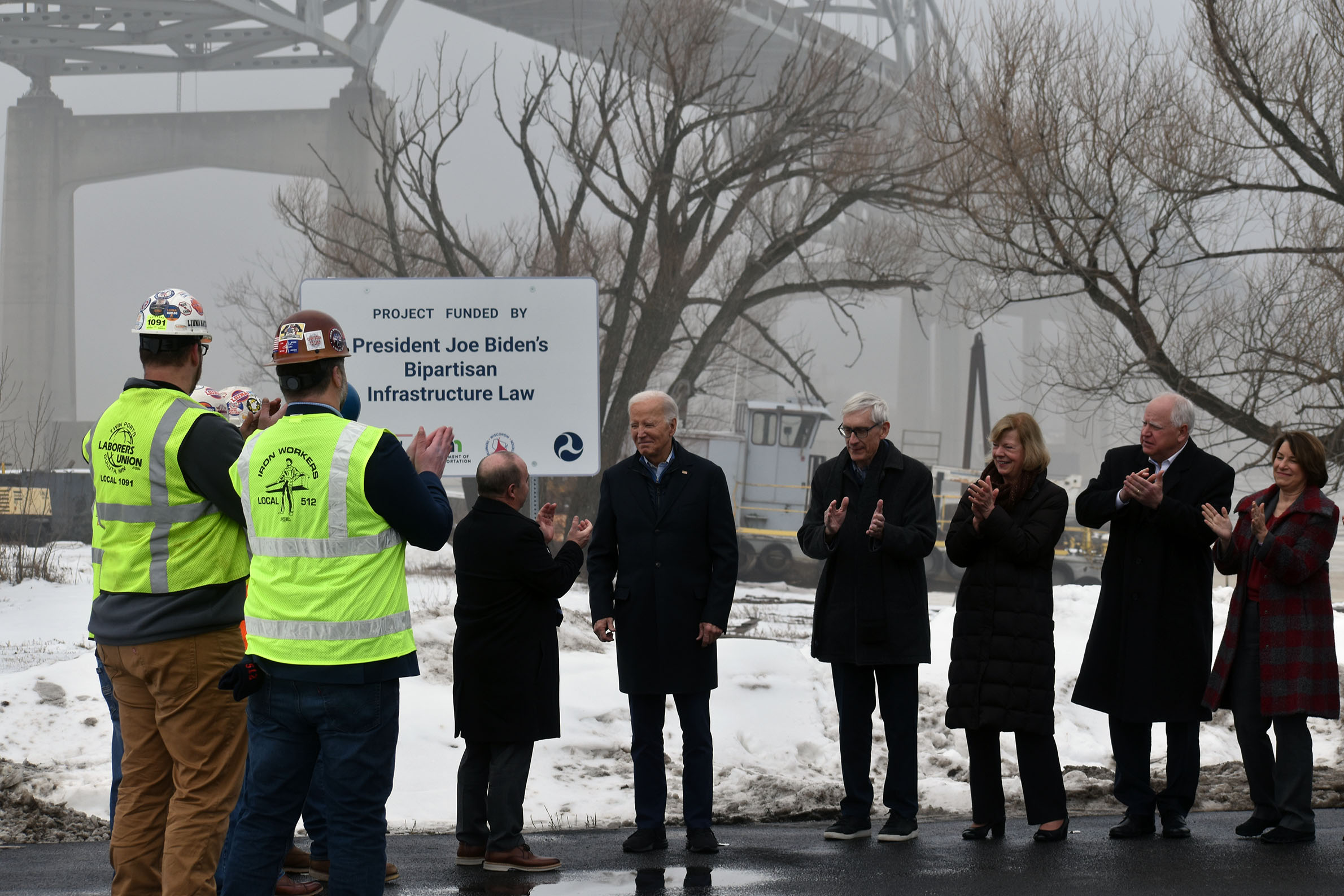 From left to right: Labor officials, former Wisconsin Transportation Secretary Craig Thompson, Wisconsin Gov. Tony Evers, Wisconsin U.S. Sen. Tammy Baldwin, Minnesota Gov. Tim Walz, and Minnesota U.S. Sen. Amy Klobuchar applaud President Joe Biden for infrastructure investments near the base of the Blatnik Bridge in Superior on Jan. 25, 2024. Danielle Kaeding/WPR
RW: The whole world is familiar with President Donald Trump’s strategy of threatening the unthinkable — from imposing 100 percent tariffs to invading Greenland — and then pulling back at the last minute. His supporters call it a strong deal-making tactic, while his detractors call it TACO, or “Trump always chickens out.” However you look at it, isn’t an effective response for the businesses just to proceed, banking on the idea that whatever was planned will happen in the long run?
JC: Our understanding is that the Minnesota Department of Transportation people are being told to keep working on the project and have not been directed to hold anything up. But we really can’t afford to have this delayed or held up. We’ve already been working on plans to get through the short-term pain of the construction. So delaying that just causes more anxiety and uninsuredness for our business owners.
RW: If you do proceed as if the replacement will continue and it doesn’t, what’s the worst-case scenario?
KP: The ultimate worst-case scenario is if the president doesn’t follow through with the agreements that have been made already, the current bridge won’t be able to be used after 2030. So that will negatively impact the businesses with the amount of traffic and because we’ll be relying on only the Bong Bridge. We don’t want to entertain that possibility that much because the uncertainty is the most frustrating thing for businesses. And every delay only is going to increase the cost.
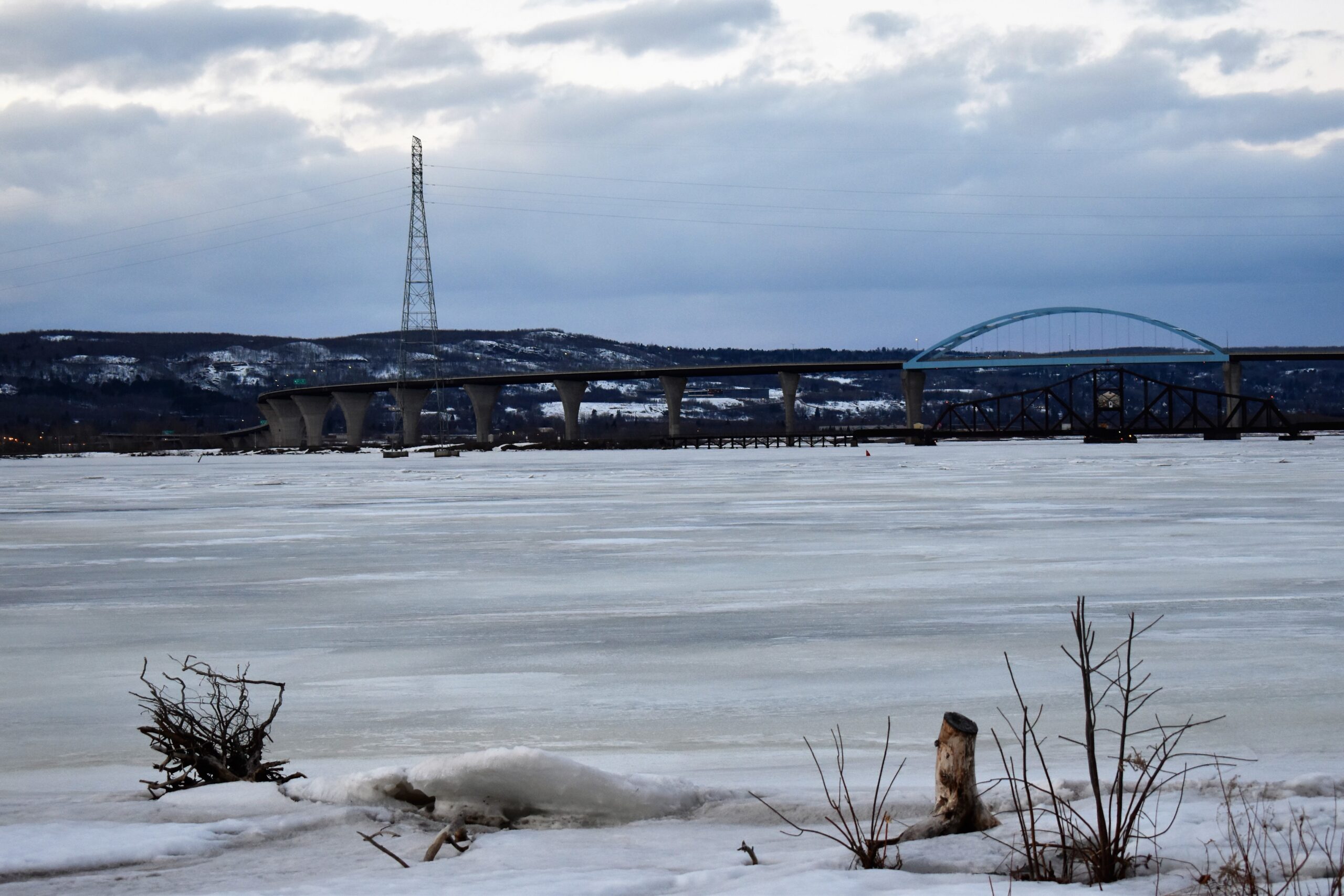 A view of the Bong Bridge spanning the St. Louis River from Billings Park in Superior, Wisc. on Tuesday, March 3, 2020. Danielle Kaeding/WPR
JC: It also holds up the state money from both Minnesota and Wisconsin as well. It’s a $1.8 billion project with $400 million coming from Wisconsin and $400 million from Minnesota. A delay can impact that money longer term.
RW: Isn’t another strategy just to wait out the administration? The bottom line is Trump’s presidential term ends in January 2029, and if we can play pundit, it’s probably safe to say that even if his successor is a Republican, they’re not likely to adopt his tactic of threatening the unthinkable and then pulling back. Wouldn’t the worst be a delay of three or years?
KP: That could be the worst case scenario. But again, the cost of construction isn’t going to decrease. So the $400 million that each state has dedicated to it may turn out to be a pittance with how much the bridge is going to cost in the end.
If you have an idea about something in northern Wisconsin you think we should talk about on Morning Edition — including an opposing view on this subject — send it to us at [email protected].